
Our approach to AI in underwriting: multiply human potential, with AI that augments underwriters instead of replacing them
Multiply human potential.
AI should take the drudge work and leave the judgment, the decision and the career with your people. That's how AFI is built. We aren't here to replace anyone.
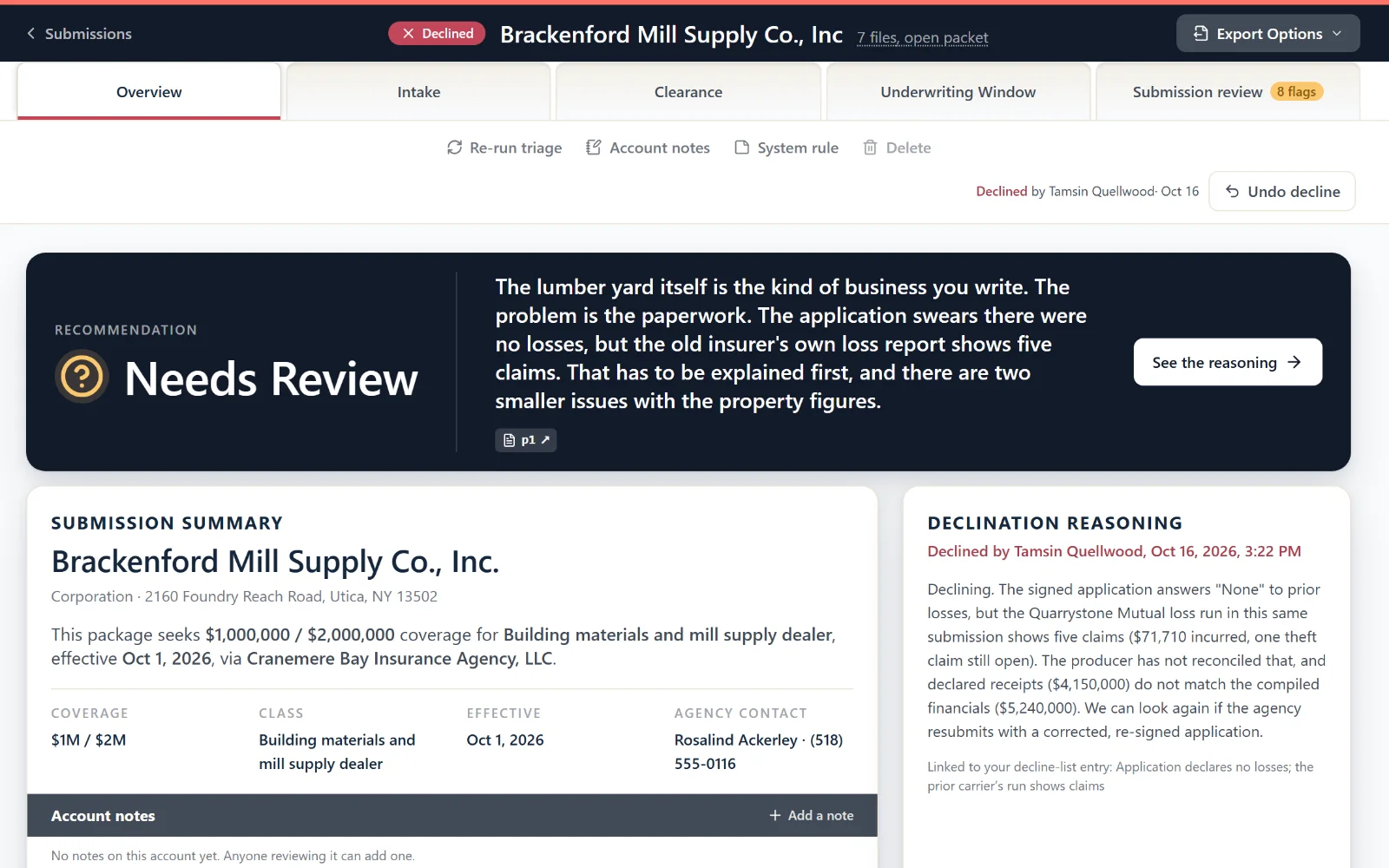
Demonstration data. Cobblefield Mutual and its submissions are fictional.
Underwriting right now
The bench is thinning, and the next generation isn't sure it wants in.
Carriers need a faster way to build underwriters, and a better answer to the AI question than cutting the people who would become them. Figures checked October 2026.
1 in 4
U.S. insurance underwriters is 55 or older.
Their median age is 44.5, against 42.1 for all U.S. workers.
54%
of 18–24-year-olds don't see insurance as a prestigious career.
Asked what the work is, their top answer is handling claims.
15%
of underwriting leaders say their firm captures what its best underwriters know.
Senior judgment leaving is their top fear, at 44%. Only 5% call AI replacing underwriters urgent.
13%
drop in employment for 22–25-year-olds in the most AI-exposed jobs.
Stanford found it concentrated where AI automates work rather than augmenting people. That choice is the whole argument.
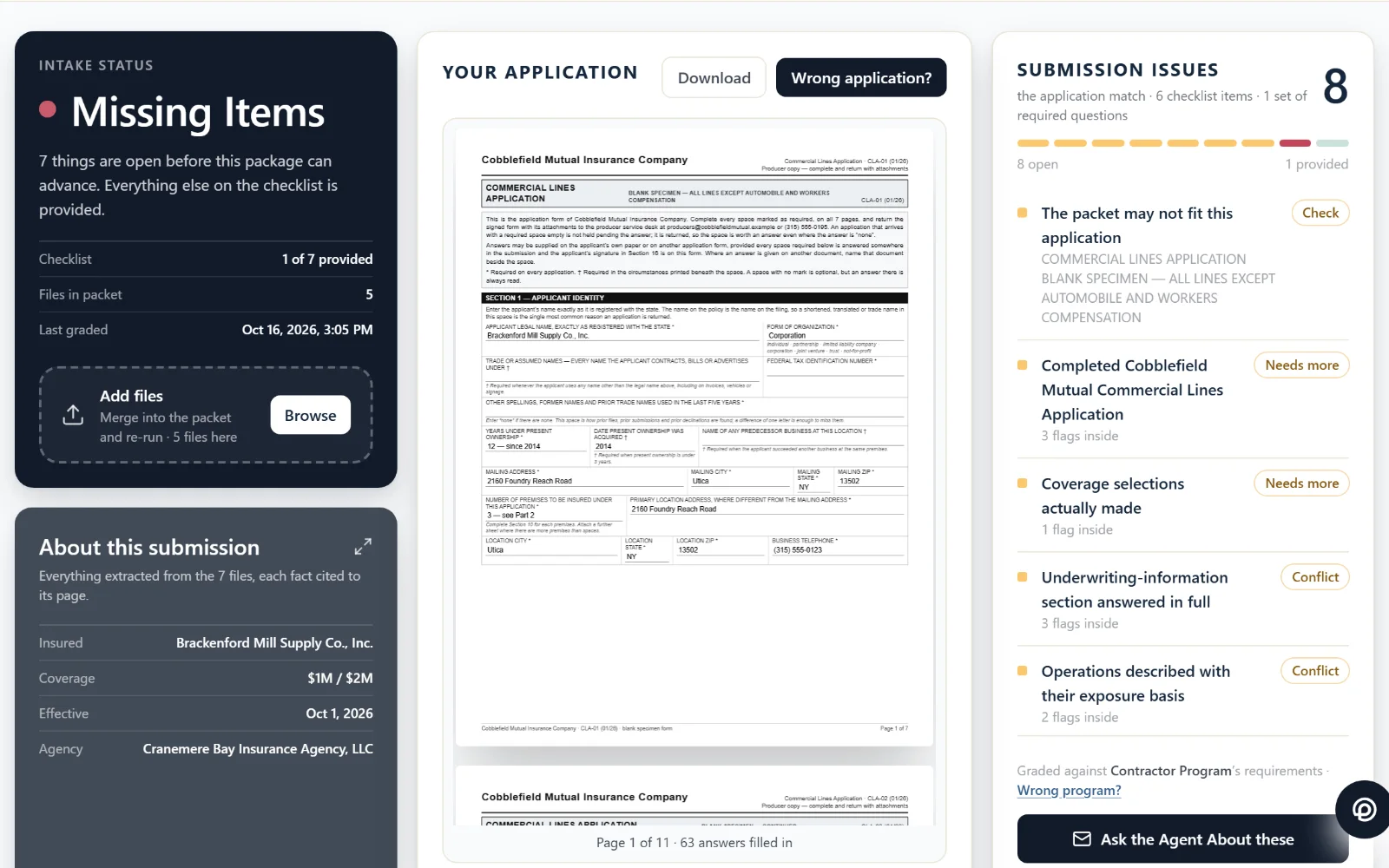
Demonstration data. Cobblefield Mutual and its submissions are fictional.
Augment, not automate
The machine does the ninety minutes. Your underwriter keeps the ten.
The bottleneck in underwriting isn't judgment. It's everything around it: reading the packet, re-keying the application, chasing missing documents and researching the applicant. AFI does that work and hands back the file with every finding cited.
- No one is replaced: the same team works more submissions with more care
- Decline and Clear to quote stay human acts, with a name on them
- And your underwriters get home for dinner on time
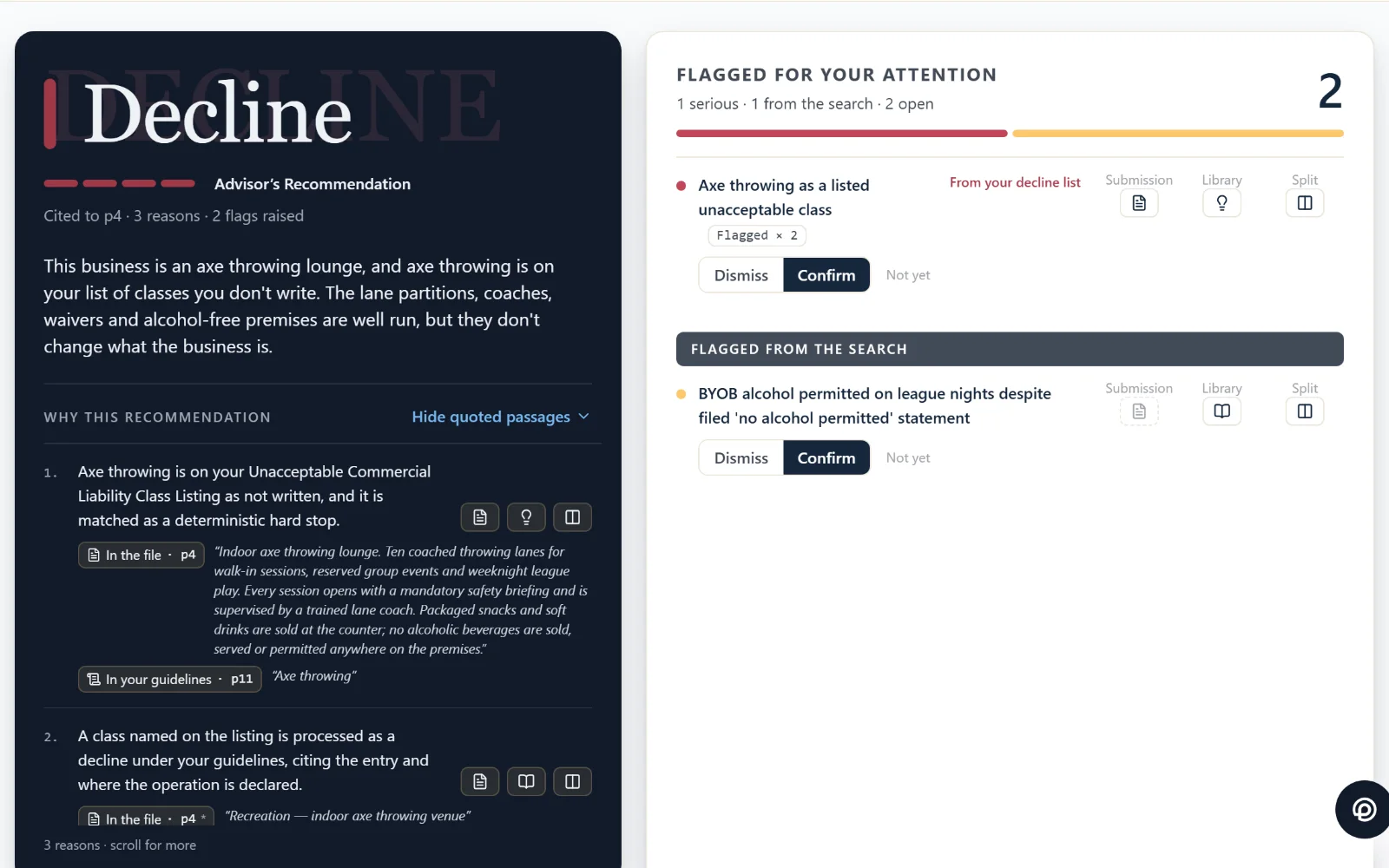
Demonstration data. Cobblefield Mutual and its submissions are fictional.
The next generation of underwriters
Learning by osmosis doesn't scale. Your guidelines can.
There have never been enough senior underwriters to sit beside every junior. With AFI, every file becomes a worked example: what was flagged, from which page of which manual, and what the underwriter confirmed or dismissed. Chief underwriting officers who use AFI tell us it helps their juniors learn to write the way they do.
- Give new underwriters the job they came for: judgment, not data entry
- Senior practice notes, approved and cited by author, so expertise outlasts the retirement party
- The junior still makes the call, so judgment gets built, not bypassed
How AFI is built
The engine is not the system.
A model scores. An agentic system acts. The NAIC Model Bulletin and NY DFS Circular Letter 7 were written when AI meant a model, and they apply to agents too. No carrier gives its best underwriter unlimited authority. AFI doesn't get it either.
Limits it can't talk its way around
What AFI may and may not do is enforced as rules at runtime. Your decline list is a hard gate. A prompt is a suggestion, not a control.
A source for everything
Every recommendation names the document, page and version it relied on, and the model that drafted it.
A person on every decision
A named underwriter makes every consequential call, with the context to make it.
A record kept as it happens
What was recommended, what it relied on, who decided and when. Append-only, and what an examiner asks for.
3–4 hrs
back to each underwriter, every day.
Accenture finds underwriters spend more than a third of their time on non-core and administrative work. AFI takes it off the desk: capacity for a team that can't hire fast enough.
Questions we hear
Straight answers about AI and underwriting jobs
Will AI replace underwriters?
Not with AFI. It takes on the reading, checking, re-keying and research that eat an underwriter's day, so the same team can work more submissions with more care. Every decision stays with a person.
Does AFI make underwriting decisions?
No. AFI recommends, with numbered reasons cited to the packet and your guidelines. Your underwriter declines or clears to quote, and the record shows who decided, when and why.
How do junior underwriters learn if AI does the work?
AFI does the drudge work, not the thinking. On every file a junior sees why a risk would be declined or cleared under your own guidelines, then makes the call themselves. It puts a senior underwriter's reasoning beside every junior, every day.
How does AI help with the underwriting talent shortage?
Two ways. It gives each underwriter 3–4 hours back a day, which is capacity you don't have to hire. And it keeps your senior underwriters' practice notes on file, cited by author, so their knowledge stays with the team after they retire.
What's the difference between an AI model and an agentic system?
A model scores: one input, one answer. An agentic system acts: it reads, checks, drafts and records across many steps. That is why AFI enforces its limits at runtime, cites a source for every recommendation and puts a named person on every decision.
Is AFI a black box?
No. Every finding links to the page it came from and the guideline clause it was checked against. A finding with no guideline behind it is marked as an observation that is not a basis for an adverse decision.
Do regulators care whether AI replaces people?
They are starting to ask. The NAIC's draft AI Risk Evaluation Supplement asks carriers whether there is a human in the loop, and whether there were staffing reductions as part of an AI system's implementation.
What does "multiply human potential" mean?
It's Polyrific's motto. We build AI that makes people more capable at their jobs, rather than AI that does their jobs. In underwriting, that means more time for judgment and less time on paperwork.
See it with your own team.
Send us one submission. Bring your most senior underwriter and your newest hire.